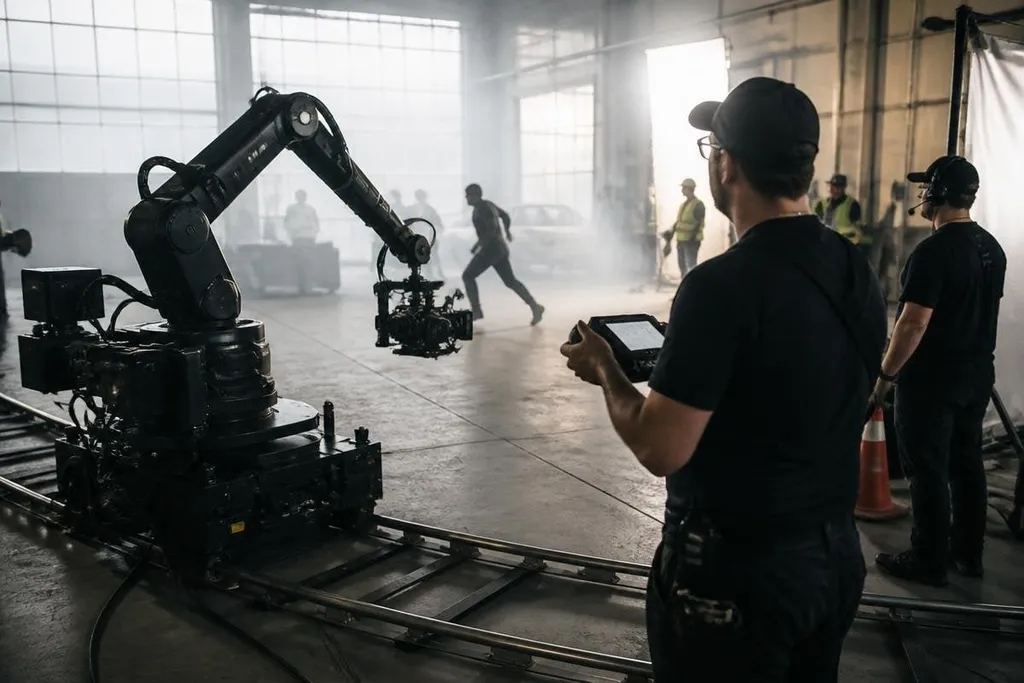
A film robot can repeat a camera move, carry gear, or move through a set without tiring. The useful question for a producer is where that repeatable motion saves time, and where people still need to control the work.
- Robots can repeat camera moves with the same path and speed.
- Remote control keeps people away from some moving equipment.
- Safety checks, set design, and crew training still decide whether the system belongs on set.
What film robots can do
Film production robots usually handle movement rather than creative decisions.
A robotic camera arm can move a camera along a programmed path, while a motorized dolly can travel across a marked track. A remote-controlled vehicle can carry a camera through a space where a full-size crew vehicle would not fit.
The main benefit is repeatability. If a director needs the same camera move after a lighting change, the robot can run the stored motion again. That helps the crew match shots across several takes, though the setup still depends on accurate marks, camera balance, and clear space around the equipment.
The same idea applies to motion-control effects. A robot can move a prop, light, or camera at a set speed while the crew changes another part of the scene. This gives the editor footage with similar timing between takes, which can help when separate shots need to join together.
Where the savings come from
A robot may reduce the physical work needed for repeated movement. It can carry a camera rig through many takes without the operator walking the same route each time. That can leave the camera crew more time for framing, focus, lighting, and checks before the next take.
The benefit depends on the shot. A simple move may be quicker to perform by hand than to program and test. A difficult move with tight timing can make the setup worthwhile because the robot repeats the path instead of asking a person to reproduce it by feel.
Motion records also include settings such as speed, position, and timing. Those records can help the crew return to a shot later, but they don't remove the need to check the physical set. A moved wall, changed floor mark, or new cable can turn an old motion file into a new hazard.
A film robot’s safety case also needs comparison with machines used outside the studio. Robot24.com robotics coverage places film automation beside industrial and autonomous systems, helping producers see where set risks differ.
The risks on a working set
Moving equipment creates a safety problem even when the path is programmed. A camera arm can carry a heavy rig through a wide arc, and a vehicle can continue moving after a person enters its route. The set needs a clear exclusion zone, a visible stop control, and a person assigned to watch the motion.
Remote operation adds another concern. The operator may not see a cable, stand, or crew member from their control position. A second person watching the robot can catch hazards that a camera feed misses, but that role must be part of the plan rather than an informal favor.
Power and network faults also matter. A loss of signal, motor fault, or software error can stop the robot in place or leave it unable to follow the planned path. The crew needs a tested stop procedure and a safe way to remove power before the first take.
The robot can also change the set itself. Heavy equipment needs a floor that can carry its load, while tracks and safety barriers take up space. A production that ignores those needs may lose more time in setup than it gains during repeated takes.
A practical decision guide
Before renting or buying a film robot, check these points:
- Name the repeated move. Write down the path, speed, camera weight, and number of takes.
- Check the floor and route. Confirm that the surface, tracks, ramps, and doorway widths suit the equipment.
- Set the safe zone. Mark where crew members may stand and who can press the stop control.
- Test the full rig. Run the camera, lens, cables, power supply, and robot together before the shoot.
- Plan for failure. Decide how the crew will stop, power down, and move the robot after a fault.
- Compare setup time. Measure the robot workflow against a manual move for the actual shot.
Where robots fit best
Film robots make the most sense when a shot needs repeatable motion, tight timing, or a camera position that is hard for a person to hold. They fit less well when the scene changes from take to take or when the setup space is too small for a controlled route.
I'd use a robot for a repeatable camera move only after the full path and stop procedure worked with the real rig. That standard protects the crew and gives the production a fair cost comparison.
The open question is how much set work future systems can handle without adding more people to watch them. For now, the strongest case remains narrow: automate the movement that repeats, keep people in control, and measure the setup before the first take.